
Getting an English MRI report in China involves more than asking for the scan results. A foreign patient may need to confirm the language of the original hospital report, whether an English translation can be arranged, and whether the complete image study can be downloaded or only viewed through a hospital platform.
These are separate questions. A written report, an English translation, printed film and a complete DICOM study are not interchangeable. Emma Medical Concierge can help coordinate these practical details with the selected hospital, but we do not interpret MRI images, issue radiology reports or provide a diagnosis.
Quick Answer for International Patients
An English MRI report in China is not something to assume before the examination. Ask the selected hospital which language the original radiology report will use and whether it can issue an English version. If it cannot, an English translation may be arranged separately, but that translation does not become a new radiology opinion.
You should also ask how the images will be delivered. Some hospitals use a QR code, official account, patient portal or cloud link, others may offer a CD, USB drive, or in-person collection. Confirm whether you can receive the complete study in DICOM format, whether the link allows downloading rather than viewing only, and whether it will still work after you leave China.
If you are still arranging the examination itself, read our guide to booking an MRI in Chengdu as a foreign patient.
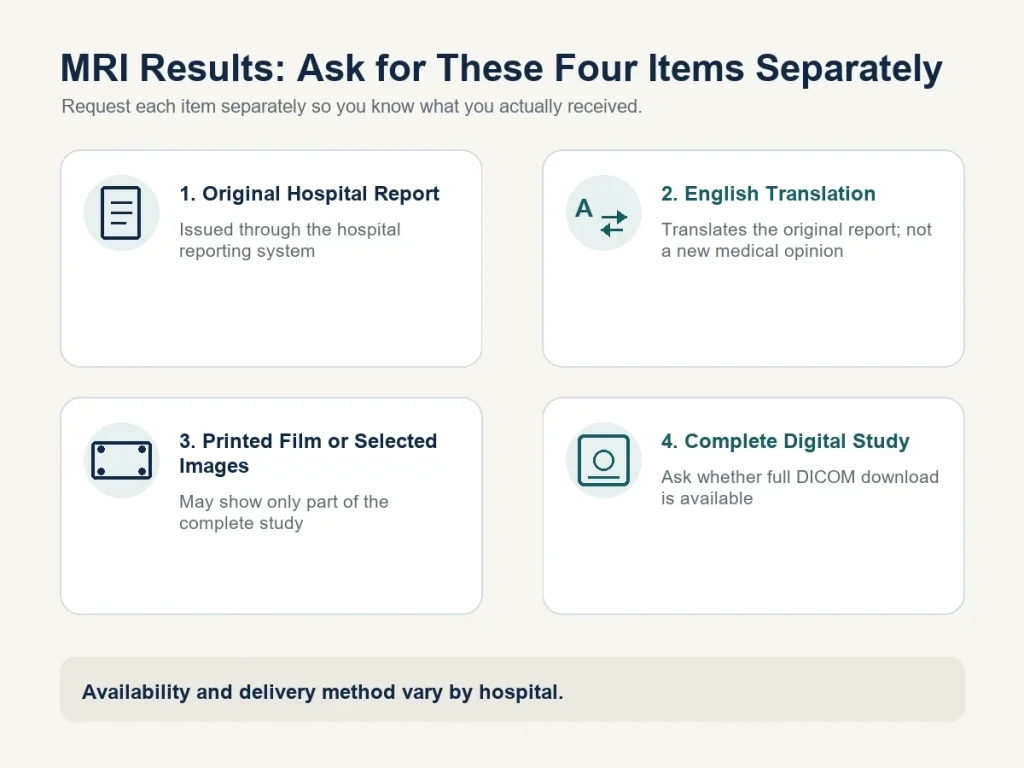
Ask for These Four MRI Deliverables Separately
When arranging an English MRI report in China, ask about each deliverable by name. This avoids discovering after the scan that you have a report but not the full image files, or a mobile viewer that your doctor at home cannot access.
| Deliverable | What it is | What to confirm |
|---|---|---|
| Original hospital report | The report issued through the hospital’s radiology reporting system | Language, release time, collection method and whether it carries the hospital’s normal authentication |
| English translation | A translation of the original report | Translator, format, turnaround time and whether the receiving organization requires certification |
| Printed film or selected images | A physical film or limited set of displayed images | Whether your doctor actually wants this and whether it represents only selected images |
| Complete digital image study | The hospital-provided digital files, potentially in DICOM format | Completeness, download method, access requirements, expiry and overseas usability |
Hospital fees and deliverables can be billed differently. Our guide to MRI cost in China explains why the scan fee should be checked separately from translation, digital export, physical media and other possible services.
Original Hospital Report vs English Translation
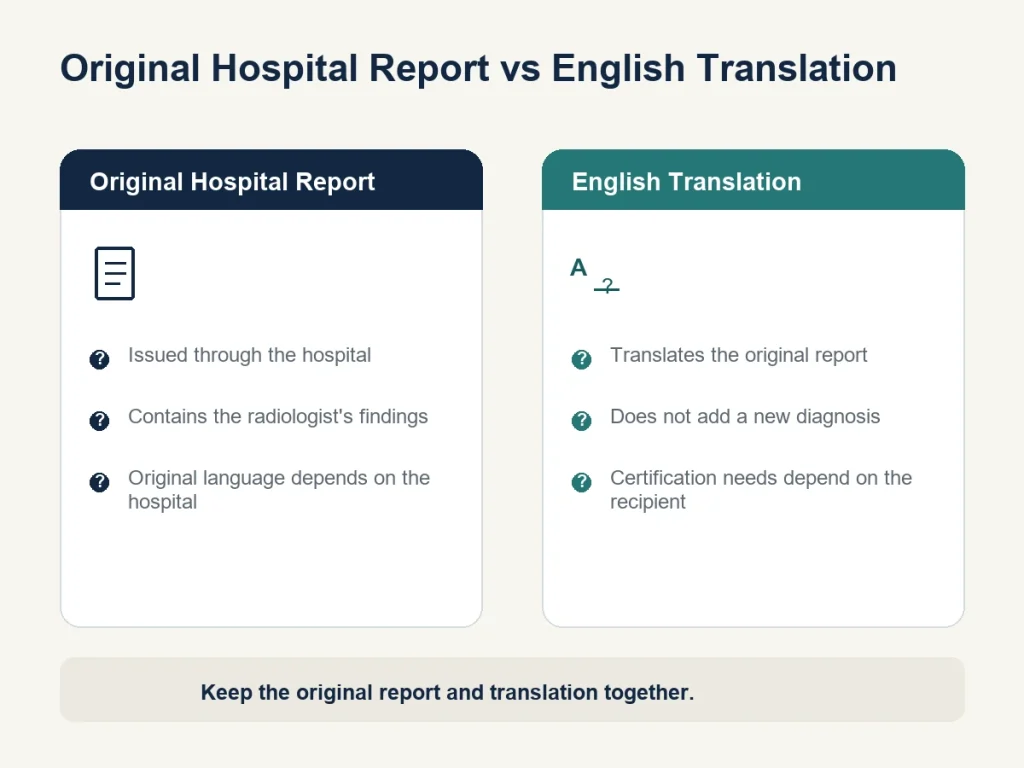
A radiology report is written after a radiologist reviews the examination. RadiologyInfo explains that the radiologist interprets the images and writes a report for the referring or treating healthcare provider.
An English translation has a different role. It translates the content of the original report so that an English-speaking doctor or other authorized recipient can read it. It does not add a new diagnosis, change the findings or become a second radiology interpretation.
If you need an English MRI report in China, ask this exact question:
Will the hospital issue an original radiology report in English, or will I receive the original report in Chinese with a separate English translation?
The distinction is especially important when the document will be used for insurance, legal proceedings, immigration, a formal second opinion or another regulated purpose. The receiving organization—not Emma—decides whether it needs a certified translation, a named translator, a hospital stamp or another specific format.
Keep the original report together with the translation. Your doctor may want to compare the translated text with the source document and the actual image study.
MRI Report vs MRI Images
The report summarizes the radiologist’s findings. The images are the scan data reviewed to produce that report. A patient may need both.
A doctor at home might use the written report to understand the hospital’s findings, but may also request the complete images for review, comparison with previous examinations or treatment planning. This does not mean every doctor will accept every hospital platform or file-delivery method.
Before the examination, ask your receiving doctor:
- Do you need the original report as well as the English translation?
- Do you need the complete digital study?
- Do you specifically require DICOM files?
- Can your clinic open a secure cloud link, or does it need downloaded files?
- Is printed film useful, or is it unnecessary?
- Are there any upload, file-size or portal requirements?
Asking the receiving doctor first can prevent unnecessary printing and reduce the risk of leaving China without the required files.
What Are DICOM Files?
DICOM—Digital Imaging and Communications in Medicine—is the international standard for medical images and related information. It helps imaging equipment and healthcare systems store and exchange image studies in a structured form.
A DICOM study is more than a folder of ordinary pictures. The DICOM Standard key concepts explain that DICOM data sets can include image data together with patient identification and examination information. A study can contain multiple series and many individual images.
This creates two practical rules:
- Do not assume that JPEG screenshots, a PDF report or photographs of printed film equal the complete DICOM study.
- Treat DICOM files as private medical information. Do not post them, their QR codes or access links in public comments or social media groups.
An online hospital viewer may display images generated from the study without offering the original files for permanent download. Ask whether the hospital provides the complete study, what format it uses and how the files can be transferred to your doctor.
How Chinese Hospitals May Deliver MRI Results
China has national technical standards covering digital medical-image exchange. The National Health Commission’s Medical Digital Imaging Virtual Printing Information Exchange Specification references DICOM and applies to medical institutions and imaging information systems.
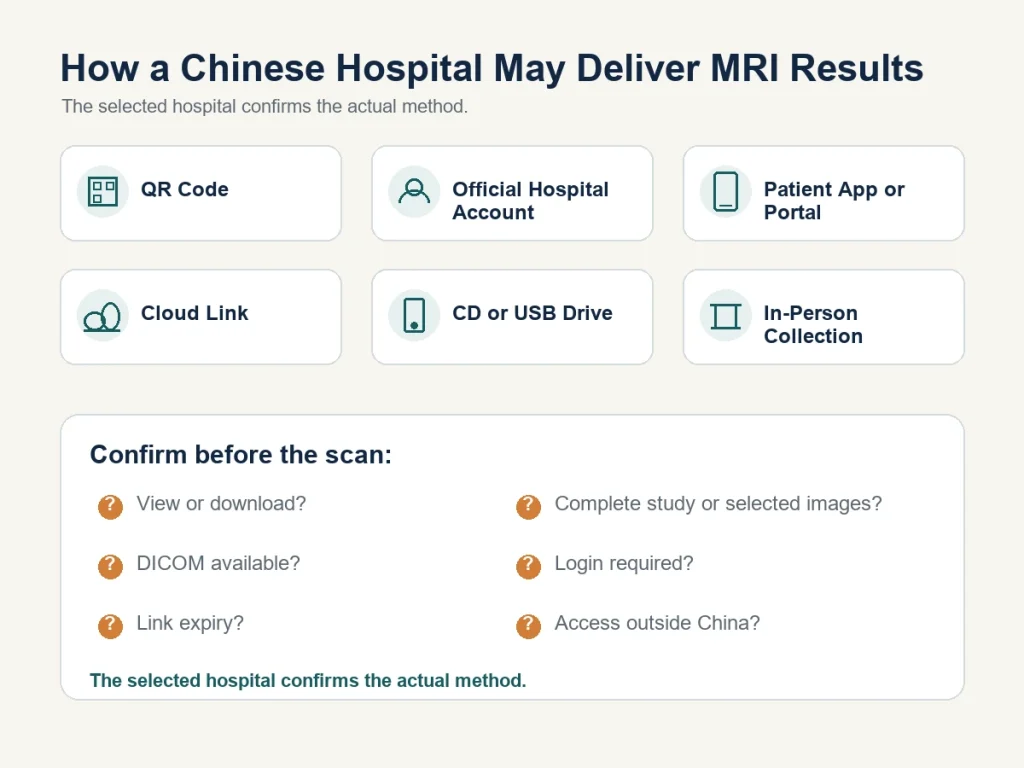
Patient-facing delivery still varies by hospital. Possible methods include:
- a QR code printed on the report;
- an official hospital WeChat account;
- a hospital app or patient portal;
- a shareable cloud-imaging link;
- CD or other physical media;
- USB drive export where available;
- collection from a radiology or records desk.
For example, the Sichuan Provincial People’s Hospital radiology department describes a cloud-film service. Other official Chinese hospital guides show QR-code and official-account workflows for viewing reports and images. These examples demonstrate possible delivery routes; they do not establish one rule for every hospital in Chengdu or China.
An English MRI report in China and the image-delivery route should therefore be confirmed for the selected hospital, examination and patient registration pathway.
Questions to Ask About QR Codes, Apps and Cloud Links
A QR code can be convenient, but “I can see the images on my phone” is not the same as “I have the complete image study in a format my doctor can use.”
Ask the hospital:
- Does the link include the written report, images or both?
- Does it show the complete examination or only selected images?
- Can the full study be downloaded, or is it view-only?
- If downloadable, is it supplied in DICOM format?
- Does access require a Chinese phone number, hospital account, electronic health card, WeChat login or identity verification?
- Can the link be opened outside China?
- Does the link expire?
- Can access be shared securely with a doctor?
- Is there a charge for export, disc, USB or printed film?
- Who should be contacted if the files do not open?
Do not wait until you are at the airport to test the link. Open it on the device you plan to use, check the report and image sections, and confirm the handover method while you can still contact the hospital team locally.
What to Check Before Leaving China
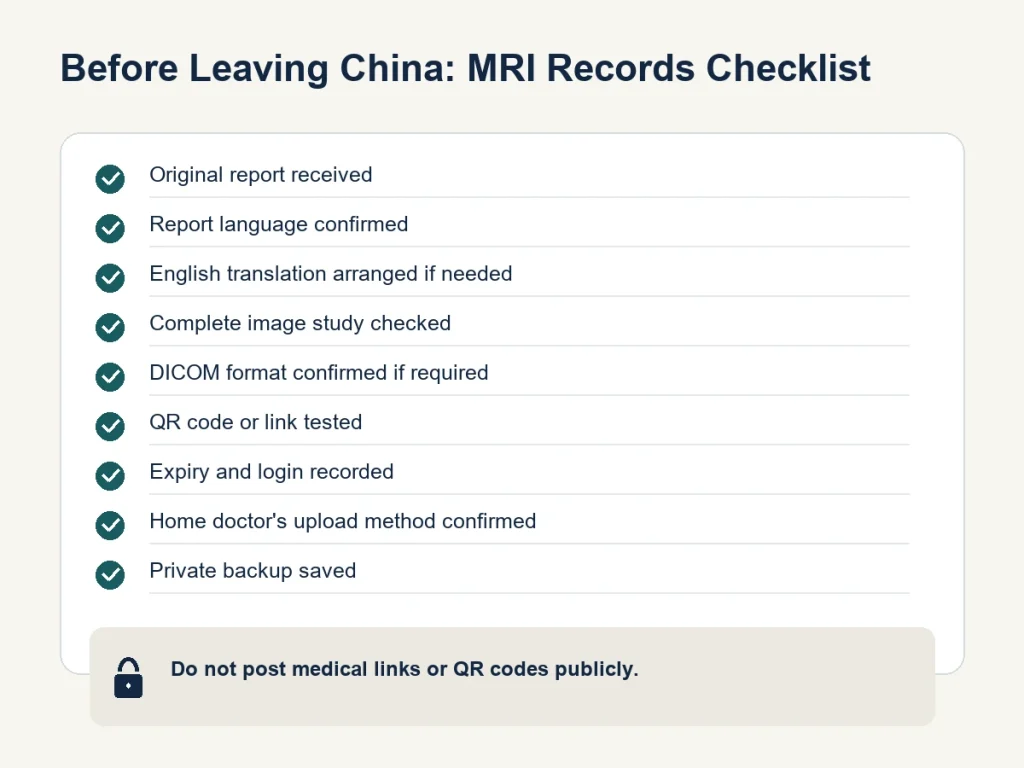
Use this checklist after the report is released:
- The patient’s name and examination date are correct.
- The body area and examination match the appointment.
- The original hospital report opens and can be saved where permitted.
- The report language is confirmed.
- The English translation has been received or its delivery arrangement is documented.
- The image study opens on the intended device.
- The study appears to contain all expected series rather than only screenshots.
- The hospital has confirmed whether the download is DICOM.
- The QR code or cloud link has been tested.
- Expiry and login requirements are recorded.
- The files can be shared through the receiving doctor’s approved method.
- The original report and translation are stored together.
Do not alter the original report or remove information from the hospital copy. If a name, date or examination detail appears incorrect, ask the hospital to review it through its own correction process.
Sharing MRI Records With Your Doctor at Home
Before sending large files, ask the receiving clinic what it accepts. Some clinics use secure upload portals; others may accept a hospital cloud link, encrypted file transfer or physical media. Email attachments may be too small for a complete MRI study and may not meet the clinic’s privacy requirements.
Send or retain:
- the original hospital report;
- the English translation, if arranged;
- the complete image study in the confirmed format;
- the examination date, hospital name and body area;
- any access instructions or expiry date;
- relevant previous imaging for comparison, if your doctor requests it.
Do not claim that an English MRI report in China will automatically be accepted by every doctor, insurer or authority. The receiving organization controls its own clinical, technical and documentation requirements.
If your symptoms are severe or rapidly worsening, do not delay local medical assessment while waiting for translation or international file transfer.
Protecting Your Medical Information
DICOM files and cloud links may contain identifying health information. Use a private channel and share records only with the hospital, translator, coordinator or healthcare professional who needs them.
Practical precautions include:
- do not publish report photographs, QR codes or access links;
- avoid open file-sharing links without access controls;
- confirm the recipient before sending;
- use the hospital’s or receiving clinic’s approved upload route where available;
- keep a secure backup of the original files;
- obtain permission before another person forwards the records.
When contacting Emma, use the private contact route rather than public comments. We request permission before forwarding medical records to a hospital or translator.
What Emma Can and Cannot Coordinate
| Emma can help coordinate | Doctors and hospitals decide or provide |
|---|---|
| Asking what report language will be issued | The original radiology report and findings |
| Confirming possible image-delivery methods | Whether and how the complete study can be exported |
| Administrative communication about DICOM access | Medical image interpretation |
| English translation arrangements | Diagnosis and clinical follow-up |
| Testing practical access before departure | Corrections to an original hospital report |
| Private handover questions | The hospital’s release time and platform policy |
Emma Medical Concierge provides non-clinical coordination and language support. Review our medical coordination and hospital support services and full medical disclaimer.
Frequently Asked Questions
Will my MRI report be in English?
Do not assume it will be. Ask the selected hospital which language the original report will use and whether it can issue an English version. If not, a separate translation may be arranged.
Is an English translation an official hospital report?
Not automatically. A translation reproduces the original report in another language. It is not a new report signed by a hospital radiologist unless the hospital explicitly issues it that way.
Can I get full DICOM files from a Chinese hospital?
Possibly, but availability and delivery vary. Ask whether the hospital provides the complete study, whether it can be downloaded in DICOM format and whether export has a separate process or charge.
Can I use a QR code after leaving China?
It depends on the hospital platform. Test the link before departure and ask about expiry, overseas access, account requirements and whether the files can be downloaded.
Will my doctor at home accept the files?
Only the receiving doctor or clinic can confirm that. Ask what report language, image format and transfer method it requires before the scan.
Can Emma interpret my MRI?
No. Emma can coordinate communication, translation and file-handover questions. The hospital radiologist and your treating doctor are responsible for interpretation and medical advice.
How long will the report, DICOM files and translation take?
There is no universal timeframe. The examination, report release, digital-image access and translation are separate stages. Confirm each stage with the selected hospital and coordinator.
The scan date, report release, translation and image delivery can follow different timelines. For the factors that affect the appointment date itself, read MRI waiting time in China for foreigners
Start a Free Initial Case Intake
If you are trying to arrange an English MRI report in China, send the body area, selected city or hospital if known, expected travel window, and whether your doctor at home needs an English translation or complete image files.
We can help identify what the hospital still needs to confirm. The initial case intake is free. Hospital care, translation and any further coordination arrangements are confirmed separately.
Start your private MRI inquiry.
Sources
- DICOM Standard — About DICOM
- DICOM Standard — Key Concepts
- RadiologyInfo — Obtain and Share Your Medical Images
- National Health Commission — Medical Digital Imaging Virtual Printing Information Exchange Specification
- National Healthcare Security Administration — Imaging Cloud Software Application Specification
- Sichuan Provincial People’s Hospital — Radiology Department
- West China Hospital — International Medical Center
Last verified: July 18, 2026.